Making the Best Out of a Ch@tb%t Situation
SUMMARY
Rather than treating AI as a silver bullet, I reframed the problem as a UX challenge: how do we help borrowers at the exact moment they’re confused, without asking them to stop, think, and ask for help at all? The result was Loan App Guides: a lightweight, context-aware guidance system that uses AI conversationally only when it adds value, not as the default interface.
UI/UX Design
Problem Framing
User Research
Usability Testing
Foundational Research
AI Scope
MY DESIGNS
LET'S BE HONEST
A chatbot, really? 🙄
If I’m being honest, I’m not a fan of chatbots.
They’re often fast-food AI: quick, generic, and rarely satisfying. They show up when teams feel pressure to “do something with AI,” even if no one has stopped to ask whether chat is actually the right interface.
Even Nick Turley, Head of ChatGPT, has said:
"…I'm baffled by how many people have copied the paradigm rather than trying out a different way of interacting with AI…this idea that it has to be a turn-by-turn chat interaction I think is really limiting."
Chat works for ChatGPT and Claude. That doesn’t mean it should be the default everywhere else.
BACKGROUND
Just slap a chatbot on it 😒

Courtesy of about a bazillion ChatGPT prompts
The prevailing assumption was simple: When borrowers get confused, they’ll just ask the chatbot.

Chatbots come with a lot of baggage. To many users, they’re synonymous with scripted, low-trust “AI” experiences that promise help and deliver frustration.
If we were going to add a chatbot, it couldn’t become another thing borrowers had to notice, interpret, and decide to use. At a minimum, it needed to be obvious, contextual, trustworthy, and effortless.
This project became less about adding a chatbot and more about answering a deeper question: How do you help borrowers at the moment of confusion, without making them ask for help in the first place?
WHAT PROBLEM ARE WE SOLVING?
Not every question needs a chatbot
In conversations with my Design Manager, one theme kept resurfacing: borrowers will have questions during a loan application. This isn’t surprising. At its largest, our loan app experience can exceed 600 questions. Confusion is guaranteed.
Finally, discussions internally and with lenders revealed that Borrowers aren’t asking abstract questions. They’re asking very normal, very human ones:
"Why do you need my Social Security number?"
"What counts as a dependent?"
“Do I really need to list every source of income?”
How do borrowers currently get answer to questions like these? They ask their loan officer, or if they're in a hurry or just want to finish the form they'll skip the question if they can.
Success is borrowers getting what they need quickly
Measurement is ongoing, but success was defined through a set of borrower, business, and risk-focused metrics.
Loan officer follow-up questions
Questions to loan officers about the loan app are reduced.
Single-turn success rate
Borrowers get an answer from the chatbot in one response.
Abandonment after chatbot interaction
The chatbot isn't the last interaction the borrower has before leaving the application.
RESEARCH & INSIGHTS
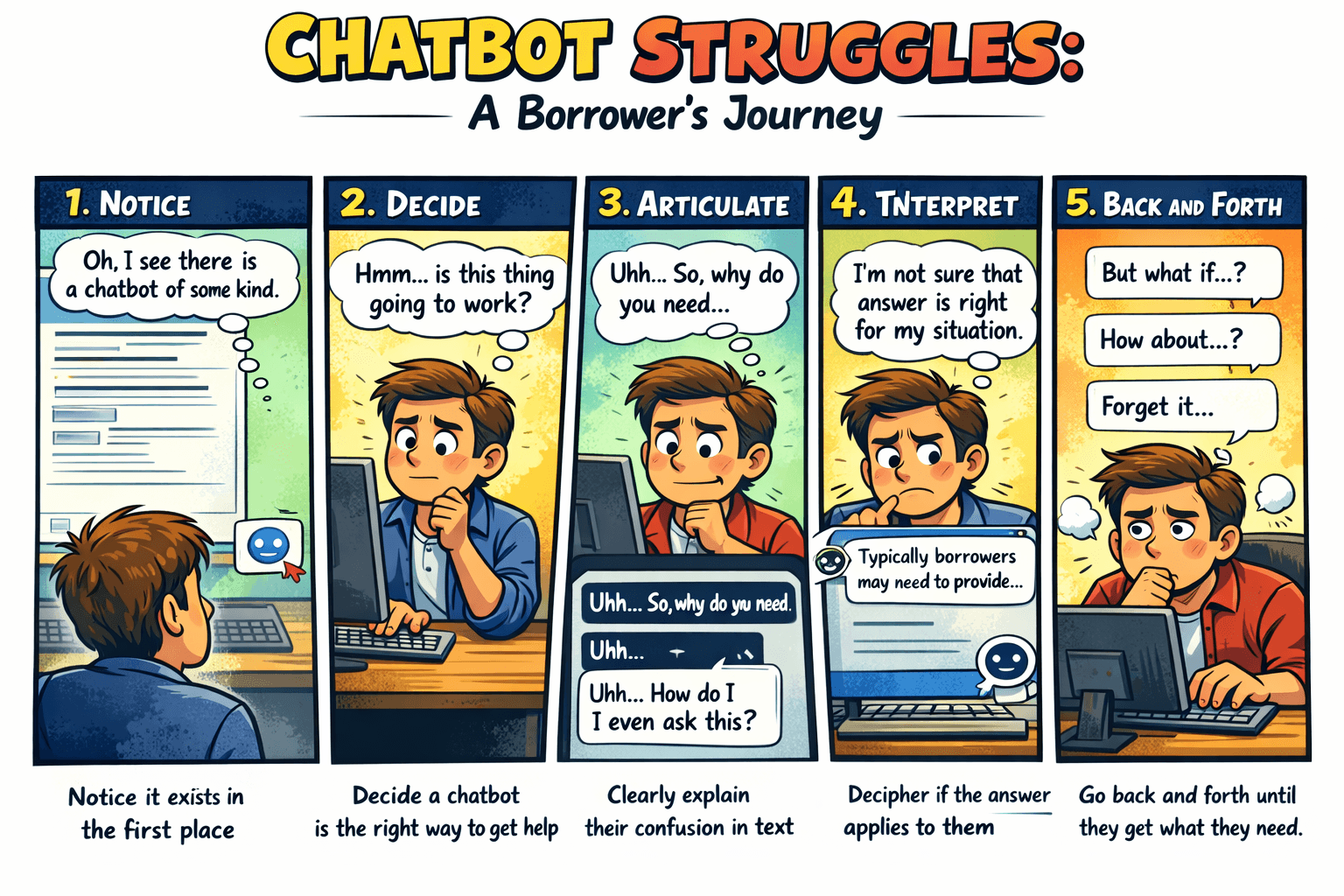
NN/g research shows that many users simply aren’t aware that chatbots exist or how they work, and that chatbots often provide limited, linear support compared with other channels. Users prefer interfaces where capabilities are obvious, and poorly signaled bot channels are often underused. Source
In a long, cognitively demanding workflow like a mortgage application, that’s a big ask.
User interviews showed appreciation for simple answers and mixed reactions for the chatbot
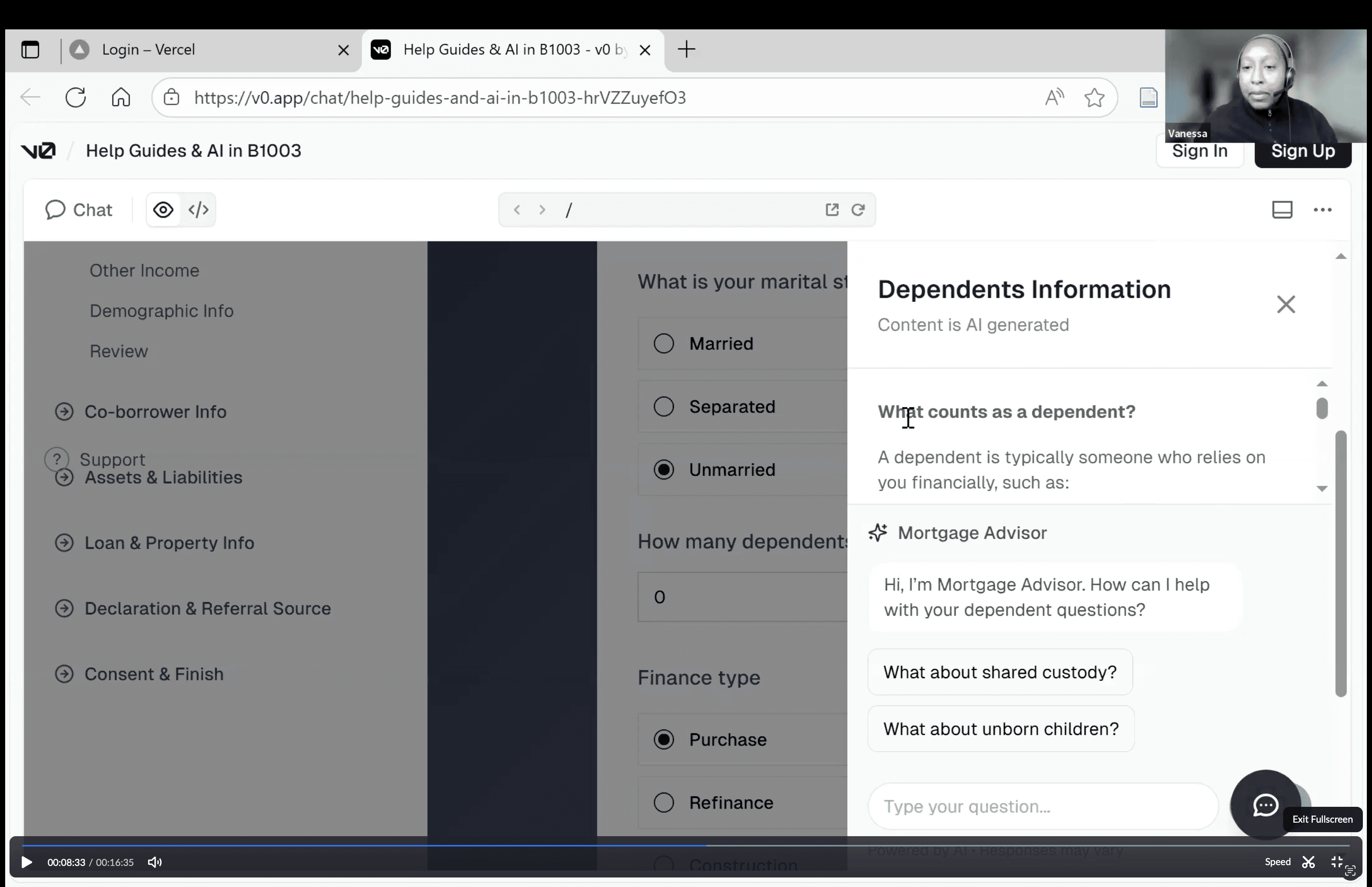
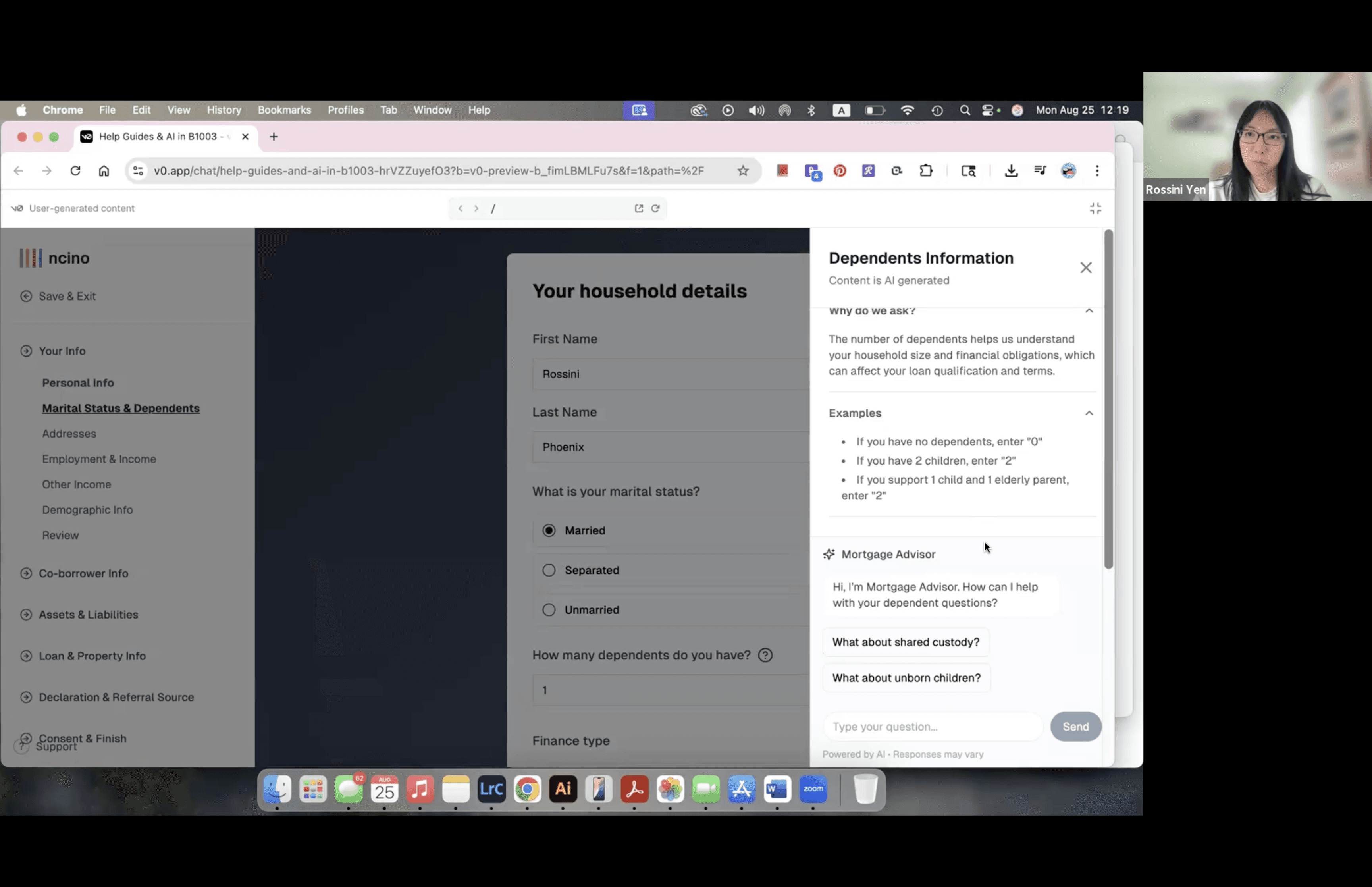
Users consistently valued the ability to resolve simple questions quickly through inline guidance, often comparing the experience favorably to established platforms with mature in-context help patterns.
While users recognized and understood the escalation from written guidance to chatbot support for more complex questions, some expressed skepticism about the chatbot’s depth—questioning whether it was a true conversational AI or a scripted FAQ. That said, all participants assumed the chatbot could competently answer questions directly related to the step they were completing.
SOLUTION
Loan App Guides
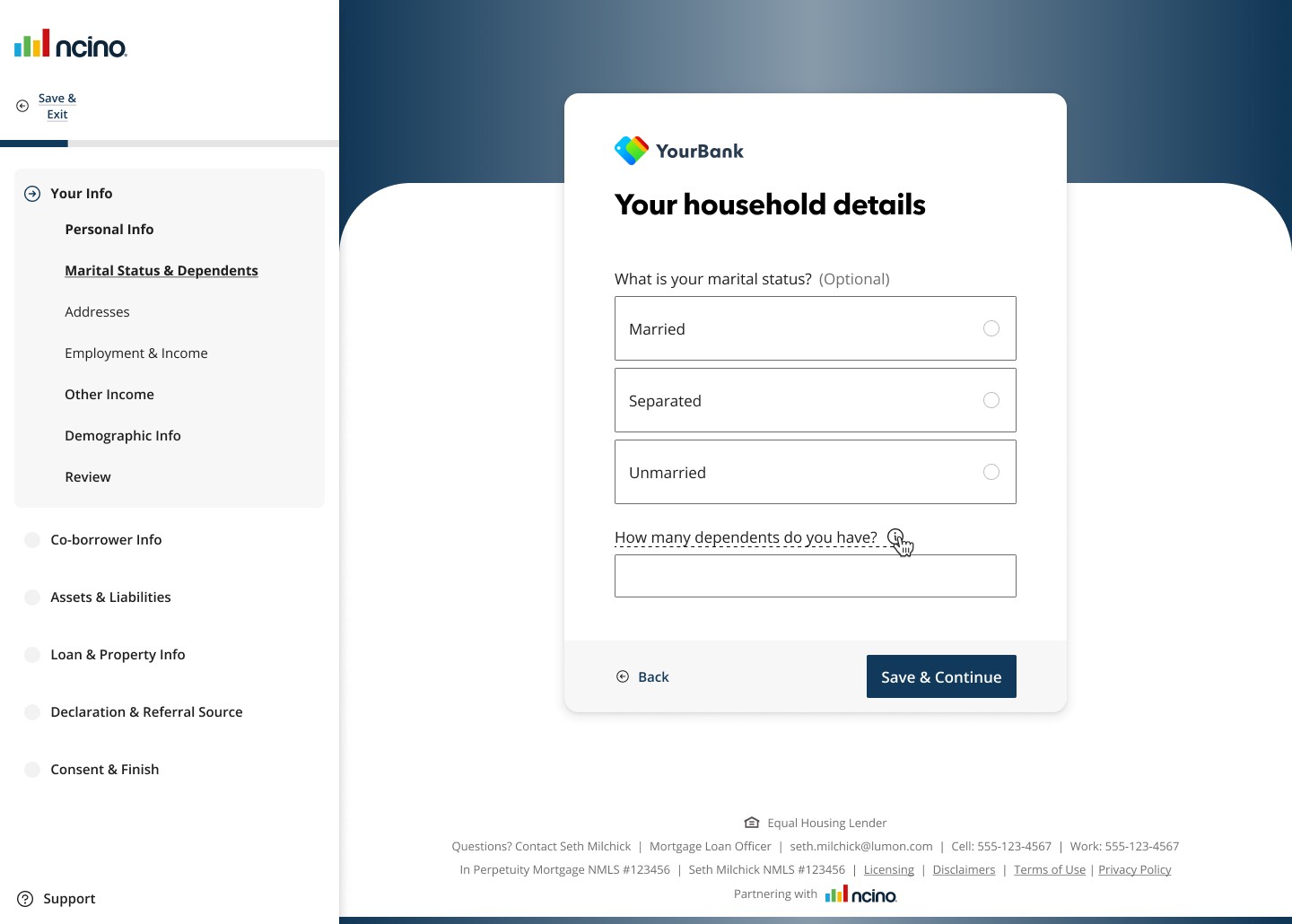
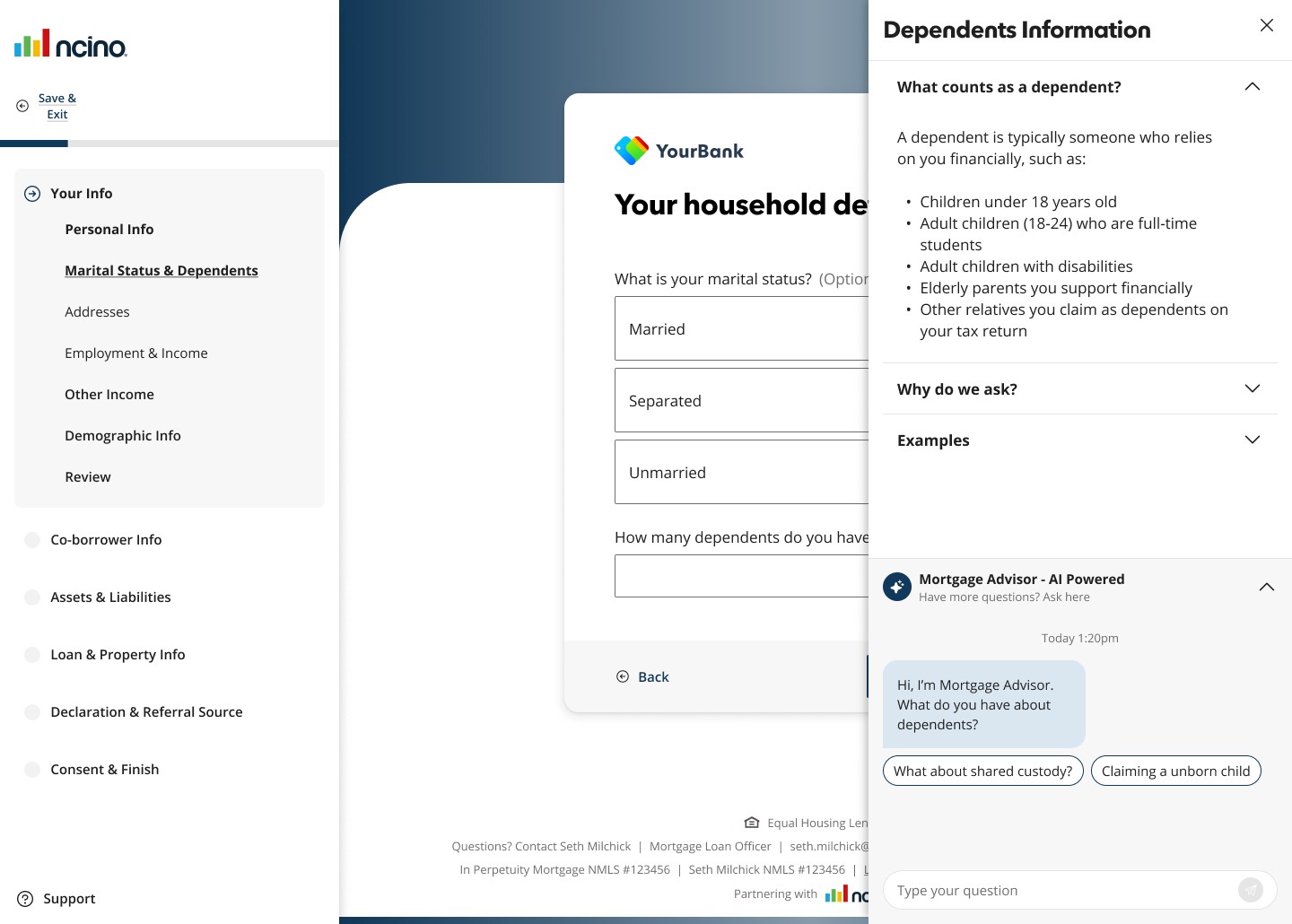
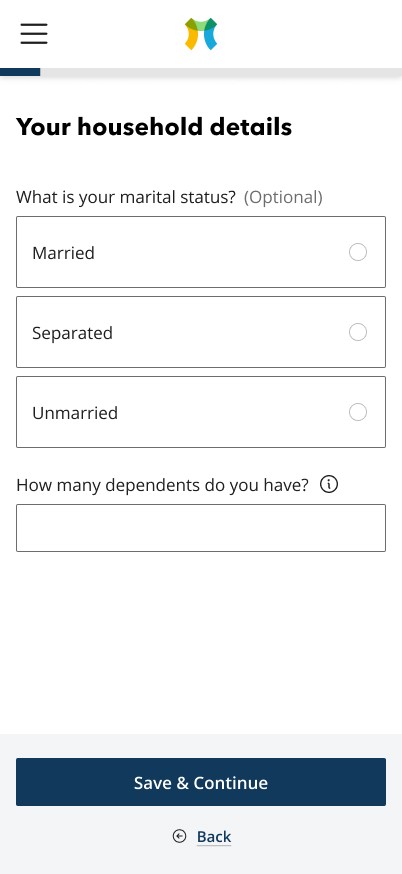
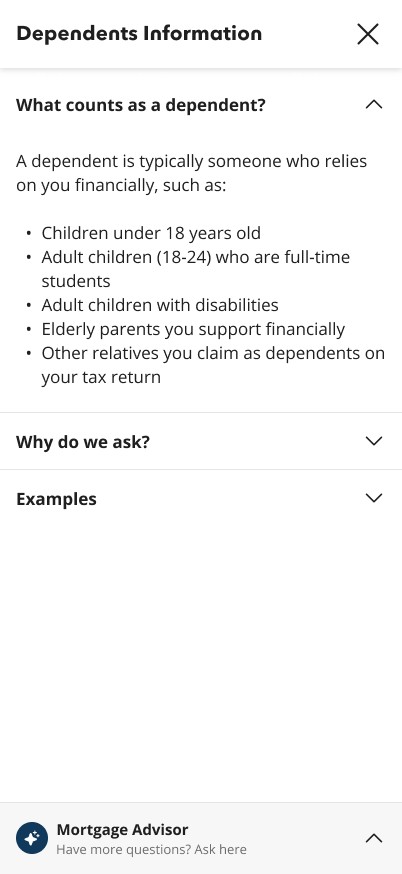
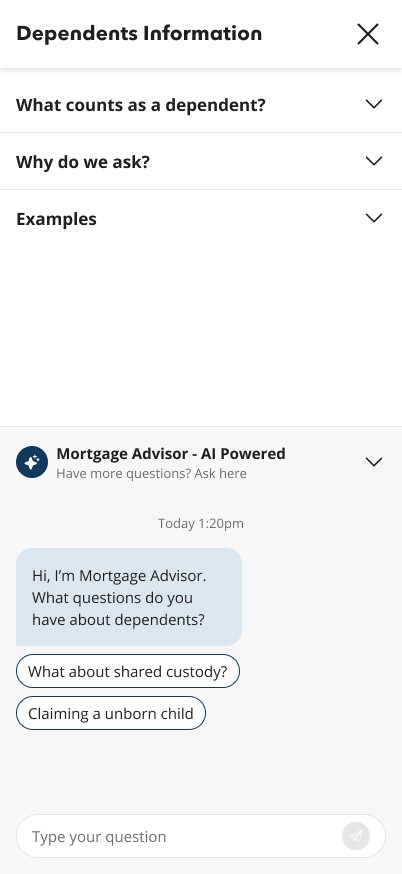
Loan App Guides meet borrowers exactly where confusion happens. Instead of asking users to summon help, we anticipate their questions and surface answers inline, at the question level. If the borrower needs more nuance, then conversational AI steps in.
No guessing where to find help, it’s right there
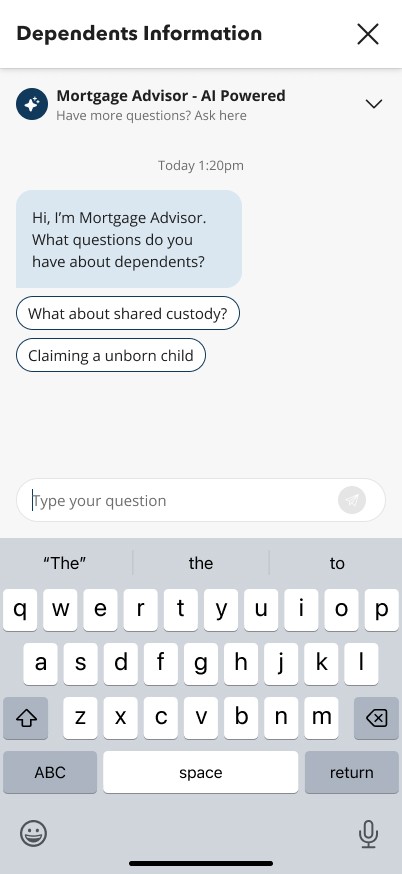
The chatbot is scoped to the current question, reducing trust and capability ambiguity
Common questions are answered instantly, without typing
The chatbot is used as an escalation path, not the primary interface
The goal was clear: Guidance first. Conversation second.
MY PROCESS
V0 prototype for the win
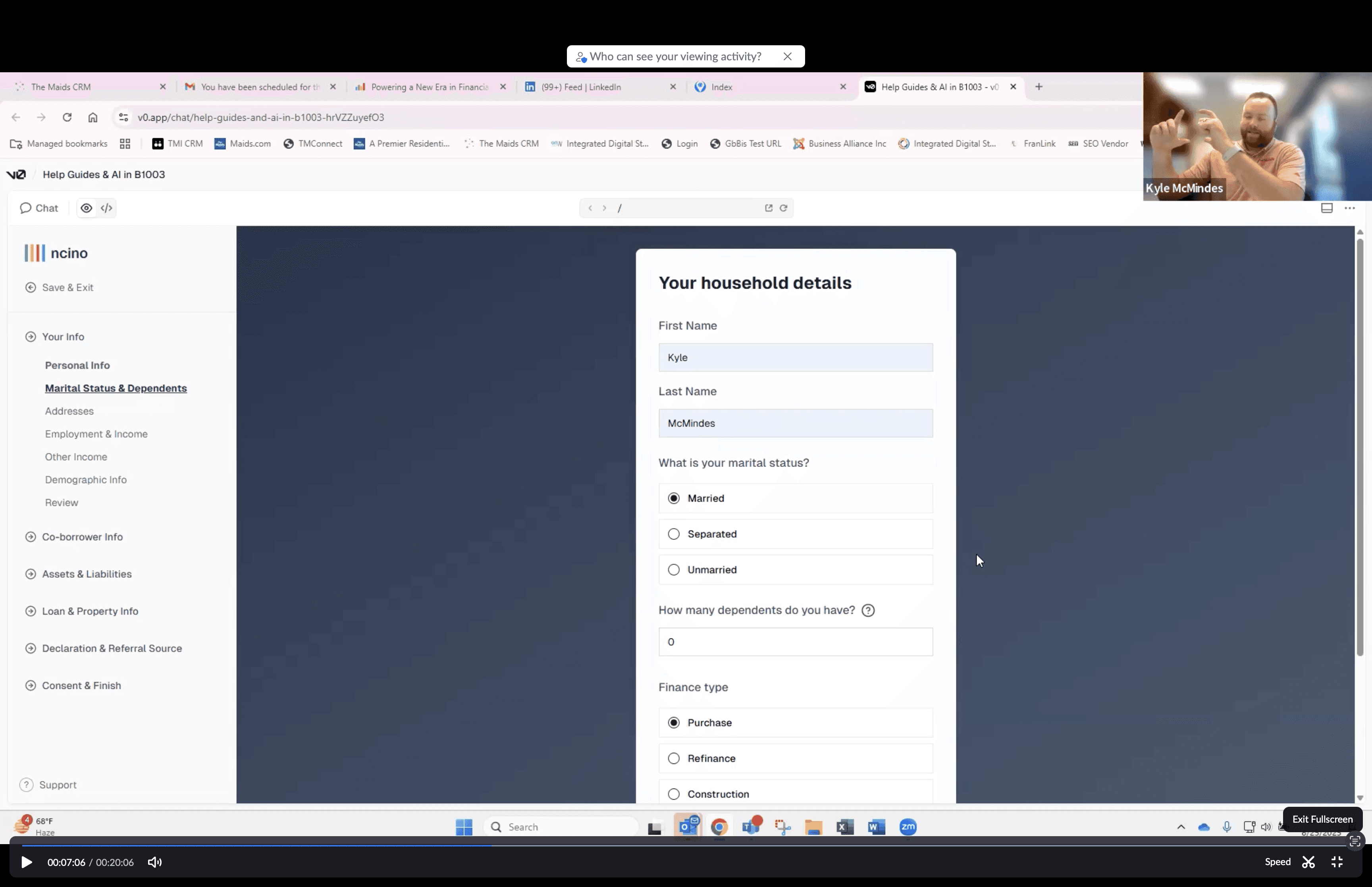
To move fast, I duplicated a single loan application screen in V0 and mocked what I called a Loan App Guide.
The concept was intentionally simple:
Click a question
See clear, human language answers
Escalate to the chatbot only if needed
The V0 prototype made the idea tangible quickly, for stakeholders and for users.
Usability testing with lenders and borrowers
I ran roughly a dozen usability sessions with both borrowers and lenders to validate:
Did users notice the guidance?
Did it reduce hesitation or backtracking?
Did AI feel helpful—or intrusive?
The feedback consistently showed:
Less reliance on external help
Faster progression through confusing sections
Higher confidence without increased cognitive load
V0 → Figma (cuz that's where we're at these days)
While V0 was great for exploration and storytelling, developer handoff still happened in Figma, where we refined states, hierarchy, and edge cases.

CONCLUSION
Sometimes the best AI is barely noticeable
This project didn’t reinvent our entire loan app from the ground up with AI, and that was the point (for now).
By reframing the request from, "add a chatbot" to a problem to solve, "how do we address confusion?", I turned an unimaginative request into a thoughtful, user-centered solution. The result was quieter, more useful help, right when it mattered.
